Showing posts with label Gardening. Show all posts

Thursday, September 23, 2010

autumn in the garden

(hey-there's that bucket sneaking in again:)

Today is a warm and rainy autumn day. It's quite lovely and cozy, but yesterday was one of those perfect midwestern fall days. The dappled sunlight and crisp air encouraged me to take some shots of my autumn garden.
A few annuals that were lovely all summer had faded a bit in these shorter days and cooler temperatures. To spark up my planters a bit, I removed the plants that had seen better days, then filled in with a selection of mum plants. Here they nestle in with bright coleus and deep purple sweet potato vine. It was an instant mood lifter for the garden and for me.
The front garden shines every fall with these bright, contrasting hues of
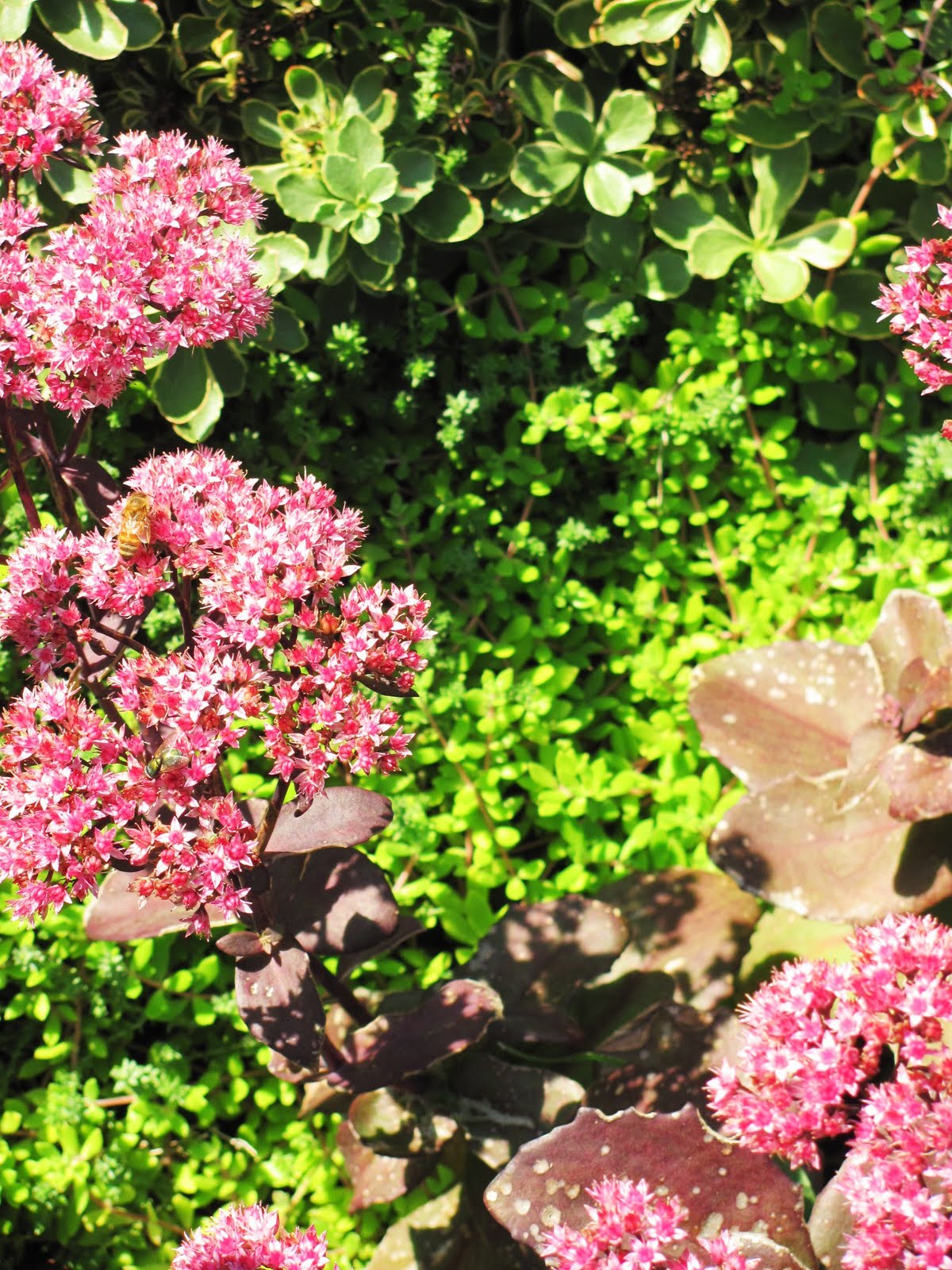
chartreuse creeping sedum and purple upright sedum.
Another mum plant welcomes visitors to my front door.
This is Pumpkin, our rent-a-kitty. He lives next door, but spends most sunny days lounging on our deck.
We think that he must know how well he fits into the color scheme.
Another sharp contrast of deep red penstemon and bright yellow-green tansy leaves! I cut this tansy back after the blooms faded in August, and it graced me with a new growth of this sparkling foliage for fall.
Cutting back blooms after their peak will often give you double the pleasure. Many plants, including coreopsis, foxglove, and perennial geraniums, will bloom a second time.  Others will just shoot up new leaves, adding a freshness to your late season garden. Additionally, leaving some of your 'spent'  perennials untrimmed (like the penstemon above) will add color interest and texture to your fall, and even winter, garden.
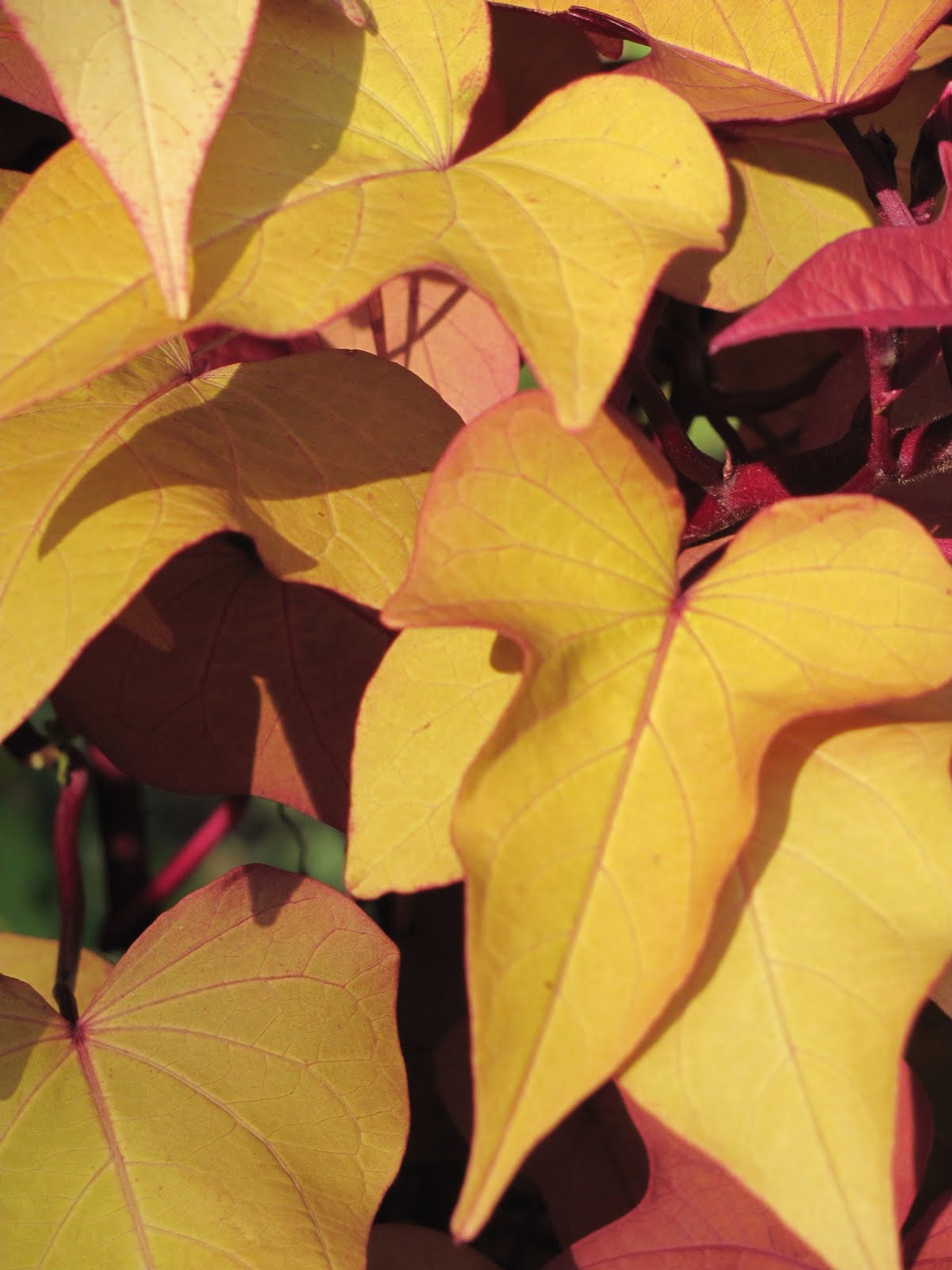
Sweet potato vine is such a lovely addition to planters, and it's colors change over the course of the season, adding new interest. This one has taken on autumn hues of buttercup and bordeaux.
What's in your autumn garden?

Thursday, May 27, 2010

Evolution of a planter

For the past two years, a really wide and squat terra cotta pot has lived in front of our house. The first year, it was filled with a giant fountain grass and looked pretty darn cool.  The second year, I planted a dwarf evergreen in it. Apparently, it was not happy in that pot, because it never made it past dwarf stage. It just stubbornly refused to grow, and my hopes of decorating it with lights for the holidays were squelched.  I was so frustrated with it, that I left it in there in the fall, and it soon got covered in snow and forgotten.
Needless to say, my pot full of dirt expanded and contracted in the winter weather and cracked wide open come spring. drat.
Remarkably, it cracked cleanly in half, and I saw potential in those pieces.
The top ring became the perfect collar for a lupine plant in my back garden.  It highlights the plant, and seems to have kept the bunnies from nibbling and the squirrels from digging. My lupine seems undeniably happier with it's new jewelry.
The shallow base piece of the planter lives on a metal stool in the back garden. It is the ideal depth for a mini garden full of succulents.  I filled it with evergreen stonecrop and hens and chicks.
I think I'm actually happier with the pieces than I was with the whole.


Monday, May 24, 2010

Flower pot combos

This weekend was a very productive one. We are project people. Don't go trying to change us.
Our kitchen and bathroom were being gutted, so I spent a lot of time avoiding the messy indoors, and getting some work done in the garden. I stick to perennials in my garden beds, but love to put together pots of annuals for the front steps and our new (almost finished) deck.
Coleus are always a favorite for pots, and they come in a wide variety of color combinations.  Here, I've centered the pot with purple fountain grass, then added a yellow rimmed red leaf coleus, and a ruffly purple and green coleus.  Yellow flowers kept catching my eye at the greenhouse, so I finished off the pot with some bright yellow accents-yellow lantana and some decorative yellow peppers. 
Big pots of perennials-coreopsis, blanket flower and cardinal flower-were a bargain, but I had already purchased enough new perennials for the year. Thankfully, I struck upon the idea that-DUH-I could use perennials in my pots. Sometimes the most obvious things........
'Thriller, filler, spiller' really is a good rule to follow when filling your pots. Big threadleaf coreopsis(tall, 'thriller')plants will look spectacular in these pots. I surrounded them with more coleus ('filler'), and a sweet potato vine ('spiller')-another favorite annual.
Experiement with different combinations this year, or add a new color to the mix. You'll be rewarded with lush pots full of color all summer long.

Wednesday, May 19, 2010

Going Green

Spring has put me in the mood for fresh picked bouquets.  Now that the lilacs are gone and the bleeding hearts are fading, the availability of blooms is slim.  My plants are growing and filled with buds and promise, but it will be another couple of weeks before I have a lot of colors to choose from. However, if you stretch your mind a bit, there is always something worthy of a vase.
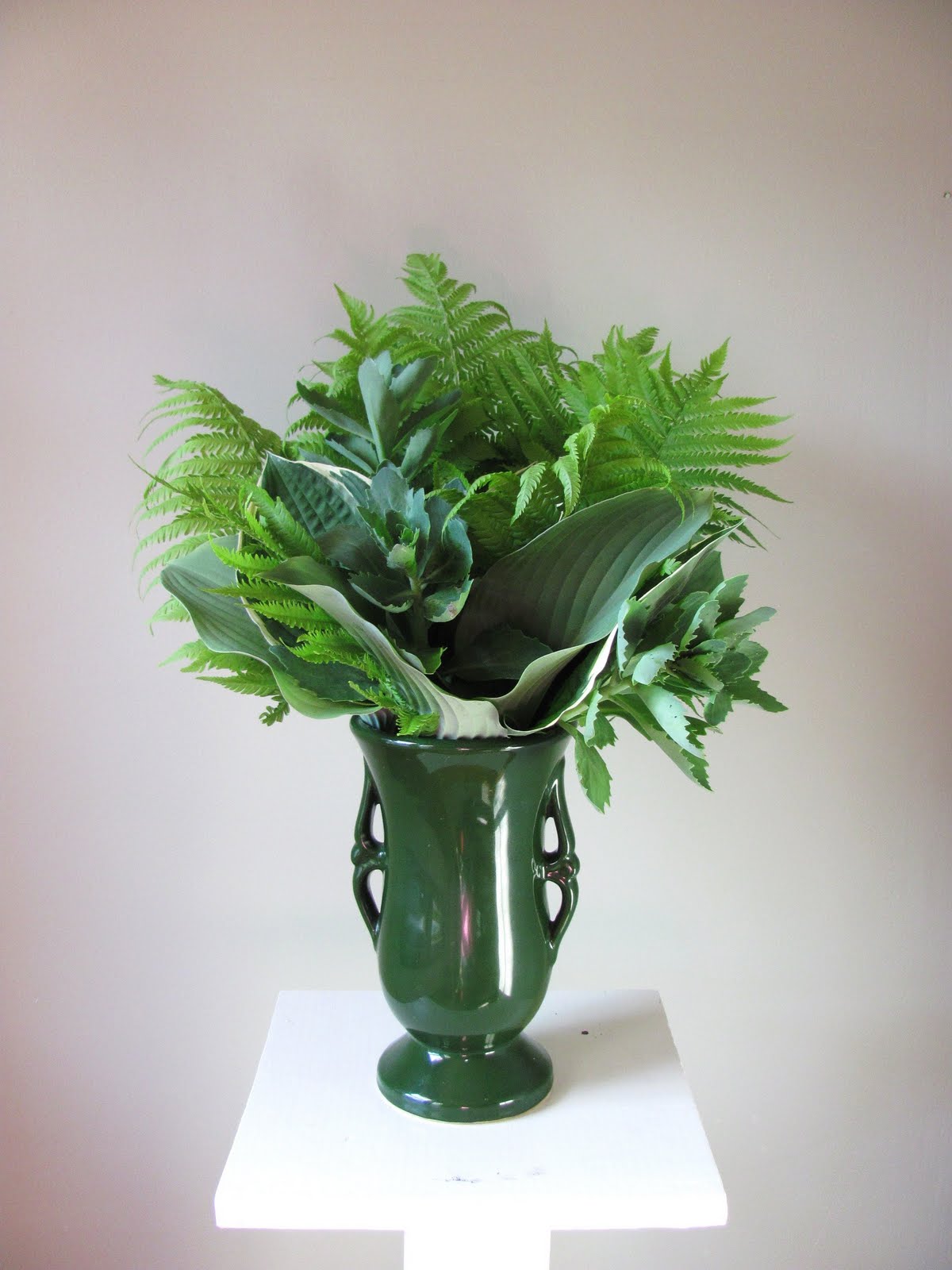
Inspired by a beautiful deep green vase that I received for a birthday gift, I picked a handful of green this morning.  I love the freshness and the monochromatic palette of this bouquet. I started with a backdrop of fern leaves, then added two varieties of hosta leaves.  Autumn Joy Sedum stalks, still in their spring green suits, add another shape and texture, and a few more fern leaves finish off the look.
The garden always holds possibility.

Monday, May 10, 2010

My top 5 perennial picks

Gardening season is in full swing, and I keep adding a few plants here and there to my garden.
I try new plants every year, but I have my favorite perennials that I use over and over again.
Here is a beginning list of my top 5 picks. These are based on performance over the years in my own gardens. They are all low fuss, low maintenance plants that add interest to the garden for an extended amount of time. 
Autumn Joy Sedum
This has become one of the most popular perennials in recent years, and with good reason.
It is extremely forgiving, drought tolerant, and grows well in most any soil.  It does the best in full sun, but is very tolerant of partial shade.  Autumn Joy comes out early in the season and grows rapidly, creating pleasing mounds of succulent green leaves by June.  It flourishes all summer long, then begins to deepen in color during the fall, adding wonderful color to the Autumn garden.  This is one of the few plants that I do not cut back in the fall, because the tall bare stalks add interest to the Winter garden.  It's really a 4 season charmer.  Once this plant is established, it can (and should) be divided regularly.  It's easy to do and will allow you to add more plants to your garden or share with friends and neighbors.
Lady's Mantle
Lady's Mantle is one of my very favorite plants.  Although a staple in English cottage gardens, it does not seem to enjoy the same popularity in the States.  This is another easy to grow plant that does best in full sun, but will tolerate partial shade.  I love this plant because it forms a lovely compact mound of frilly leaves that hold droplets of water when it rains.  In late May to early June it sends out frilly yellow blooms on long stalks, adding even more interest to this sweet plant.  Once the blooms are spent, clip them off, and you will enjoy the foliage late into the fall, when it yellows.  Your plants will send out little offspring that are easy to move and are quick to develop into new plants.These are a wonderful choice for a cottage garden, border, or even a more manicured garden bed.
Mountain Bluets
These plants are also know as perennial Bachelor Buttons.  I can't believe how fantastic these are.  Their elongated leaves come out in early spring and quickly grow to 12-14".  Mine are already blooming profusely this year, which is amazingly early.  The flowers are rather delicate and a very brilliant blue, and look great in cut arrangments.  The really fabulous thing is that, with regular deadheading, these plants will flower from June until September!  Yup, you heard me right.
Penstemon-"Husker Red"
Another early riser, Penstemon's green and red foliage will look great in the Spring.  By mid-summer, they have tall white to light pink flowers that last through early fall.  Cut the flowers back when they are spent, and the foliage will deepen in color and stay lively in the Fall garden.  These grow about 2 feet tall, so are wonderful for a back border plant or as a tall accent plant in your beds.
Creeping Sedums
I cannot get enough of these, and it seems like I find a new variety every time I turn around.  Green, red, chartreuse, silver-add one wherever you need a little fill in, low mound or bit of color and texture.  They really go crazy in rock gardens, creeping and crawling and mixing to create a lush carpet among the rocks. 
They are also fabulous for planters, adding texture and spilling over the sides of your pots.  They are totally forgiving (if they creep over to a spot you don't want them in-just pluck them out) and easy, easy, easy to grow.  Get some now.

As I said, these favorites are based on performance in my own gardens-they've really become tried and trues for me.  If you have questions about use in your own gardens, or about details that I may have missed, please e-mail me and I will try to help you out!

Monday, April 26, 2010

Ahhh.....Lilacs

Today I picked the first lilac bunches of the season. 
This is the first year in a very long time that they have bloomed here before May 1st. 
I paired a big handful with a few stalks of bleeding heart blooms.
My first instinct was to grab a pale blue pottery vase,
but this bright blue mid-century piece from my collection
gives these old fashion flowers a modern twist.
A few stragglers cut from the big branches combine with a branch from a blooming apple tree
to form a diminutive arrangment in this milk glass playing card holder.
The scent is already filling the house,
and I'm giddy with excitement that the fresh cut blooms season has arrived!

Thursday, April 8, 2010

you can find me in the garden

I have been a very bad blogger this week. 
You can attribute it to spring fever. 
This plant here. now. this big.
That never happens in Minnesota on April 7th.
So what is a girl to do?
Spend more time in the garden
or more time at the computer screen?
My apologies.
But I'm sure you understand.
Thank you for understanding.

Tuesday, April 6, 2010

spring treasures

My childhood home was in a river valley surrounded by lush woody areas.  There were lots of hills and ravines to explore, and I spent many many hours doing just that.  One of my greatest joys was the discovery of the first wildflowers of spring. 
Part of this past Easter weekend was spent at our family's cabin in Southern Minnesota.  The woods still look rather bare, but underneath is a developing carpet of green dotted with the earliest wildflowers, and I headed out, a little giddy, to see what I could find. 
My first discoveries were little clusters of Bloodroot. 
These flowers have large white petals with a brilliant yellow center.
They grow about 3-4" inches high.
Their most distinguishing feature is the reddish-orange liquid stored in a rhizome near the base of the stem.  This colored sap is what gives the flower it's common name.  Some Native American tribes used this substance as a medicinal treatment, skin dye or love potion.  Picking the flowers won't do you any harm, but the sap can be toxic if ingested, so take care.
I picked a small bunch and tucked them into this vintage spice tin for a cabin-worthy bouquet.
Dutchmans breeches were plentiful among the Bloodroot, but were still teeny tiny-only fit for baby dutchmen at this point.  The sunny hillside facing the lake, however, was filled with glorious bunches of pink tinted blooms.
I really love these flowers. 
They have a delicately fringed leaf that is slightly silvery, and a dangling stem full of whimiscal blooms. 
So delightful. 
A big bouquet of these graced our Easter table at the cabin.

I also dug up a few clumps to bring home, and I will try my hand at cultivating them in my city garden.
I'll let you know how they adapt.

Sunday, March 14, 2010

Spring!

March has been an unusually mild month for us thus far. 
Warm temperatures have melted all but a few small piles of snow in our yard,
and the front garden is back in full view. 
Those silly sedum are peeking their heads up.....
.......and my pussywillow tree is really getting into the act.
Happy Spring!
Christine

Monday, November 2, 2009

winterizing the garden


We finally had a weekend full of sunny skies and warmer temperatures, so I got a bit more time out in the yard to clean things up and get the gardens ready for winter.  Gardeners have many different opinions about cutting plants back and mulching gardens before winter.  I prefer to cut most things back to the ground because I feel that it helps promote new growth earlier in the spring.

I also like the neat look of having everything cut and tidy, and it leaves less work to do in the already busy spring garden. 

I do leave some plants uncut, especially sedum, to add visual interest to the winter landscape.  In the front garden, I have slowly cut back plants as they lose any color or form, leaving any that still have good fall color or have kept their shape well.  This extends the life of my garden, and keeps the front of the
 house attractive until the snow flies.


The fallen leaves add to the color to the palette as well, so they won't be raked out until I do the final cuttings.  Full leaves shouldn't be left on garden beds as mulch because they can create a heavy mat on your flowers that could smother them.  I usually do not mulch my flower beds, but if you like to, chop the leaves first, then lay a thin layer on your beds.

Here is a basic list of winterizing tasks for your yard and garden.

1. remove and compost any annuals and vegetable plants
2. cut back perennials, leaving any that hold their shape for visual interest in the winter garden
3. you may also gather seeds from your perennials at this time to store for propagating next year
4. rake leaves and compost, or shred for mulching
5. compost plants from pots, empty pots, scrub and store in garage for the winter
6. dig and divide bulbs (canna, dahlia etc.) that do not overwinter, and store in a cool indoor spot
7. plant spring bulbs before the ground freezes
8. clean, sharpen and oil your garden tools before storing for the winter

Taking care of these tasks now will make for a happy spring garden and a happy spring gardener!


Tuesday, September 29, 2009

autumn garden combo


I am getting so much pleasure right now from this lovely autumn combo of pale orange mums and bright sedum in my front garden.  I have always used a lot of sedums in my garden, but have never been a huge fan of mums as perennial garden features.  This one was irresistable because of the unusual color(I believe it is "Petno Orange", but don't hold me to that), and it may just have changed my stance on mums in my garden.  I'll be on the lookout for some more unique colors to add for next year.


Wednesday, September 2, 2009

bees and sedum

Last summer, we took up all of the grass on one side of our yard, and I planted a perennial garden in its place.  This year, that garden is thriving (mostly-always a few clunkers) and we're coming into my favorite garden season.  Oh, of course I love the first spring flowers, and the riot of color that happens in mid-summer, but I really dig the subtle changes and late bloomers of the autumn garden.  It seems that a lot of people rather give up on their gardens at this point, but I just keep cutting back any dead stuff and letting all my plants soak in cooler temps and fall light.  It also might be that it takes me all summer to really get my gardens where I want them to be, and now I can just sit back and enjoy the show (after I pull a few more weeds....)

The front bed is making me really happy, and I've got some great summer to fall transition combos right now.
The silvery leaves of perennial alyssum and dried spikes of the lamb's ear still look great against some dried yarrow (this I don't usually cut back until late as I think it adds some texture and yummy fall color to the garden).  The sedum is just coming into it's glory and is loaded with bees taking full advantage.  A little dragon's blood creeping sedum adds a splash of red, and the bright creeping sedum (sorry-not sure of the exact variety name) adds a big dose of vibrancy to the whole palette.
I wanted the front garden to be well-composed and compliment the house without overwhelming, so I kept a really tight palette and repeated a lot of plants.  The house is painted in very warm, vibrant colors, so I used  cooler, calmer tones in the garden-silver, chartreuse and deep purple.  I love sedum because they are so easy to maintain and they look great for the entire garden season, so I planted a lot of varieties (bush and creeping) repeated throughout the garden.  I sprinkled in a good dose of my favorites, including lady's mantle, penstemon and mountain bluets to round things out.
 I have been working on my list of changes for the spring, and will be doing some major changes in the back half of the garden.  Meanwhile, I'm still anxiously awaiting the blooming of an orange geranium..........   
 (oh-the tall yellow flowers in back are heliopsis-everyone asks.)